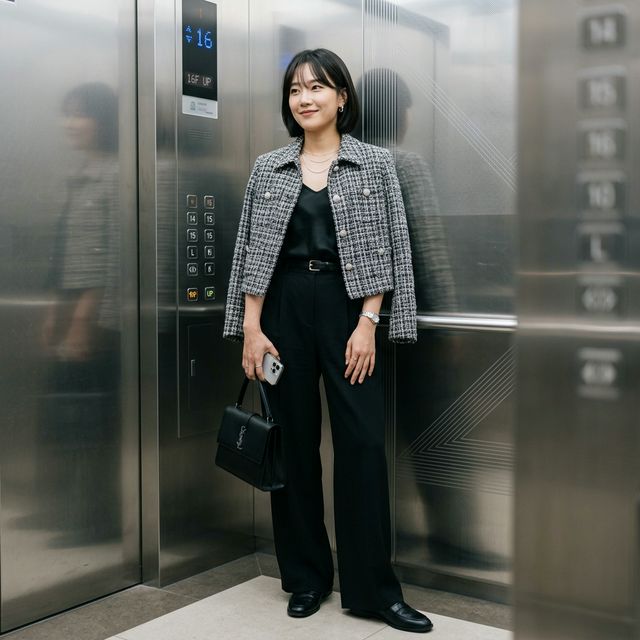
There is a specific kind of silence in a corporate elevator at 8:45 AM. It is the silence of people who have already started erasing parts of themselves before they even reach their desks. The doors close. The numbers tick upward.
Mei is standing near the back, holding an iced Americano. She is wearing a tailored, slightly cropped black tweed jacket with silver buttons, over high-waisted wide-leg charcoal trousers. To the Vice President standing next to her, she looks like a sharp, conservative professional who understands the gravity of the 9:00 AM quarterly review.
But the Vice President doesn't know the secret.
Mei knows the secret. She knows this outfit is an almost exact replica of a 4th-gen K-pop idol's airport look from a world tour departure three weeks ago. She knows the jacket was designed for a 19-year-old performing for fifty thousand people, not a 28-year-old explaining Excel projections to a board of directors.
It was a Trojan Horse made of tweed. She was smuggling her joy into a room designed to extract her energy.
We talk about "formal wear" as if it is a uniform of submission. We are told to dress for the job we want, which usually means dressing like the people who already have it. But what happens when the people who have the job look exhausted, gray, and fundamentally depleted?
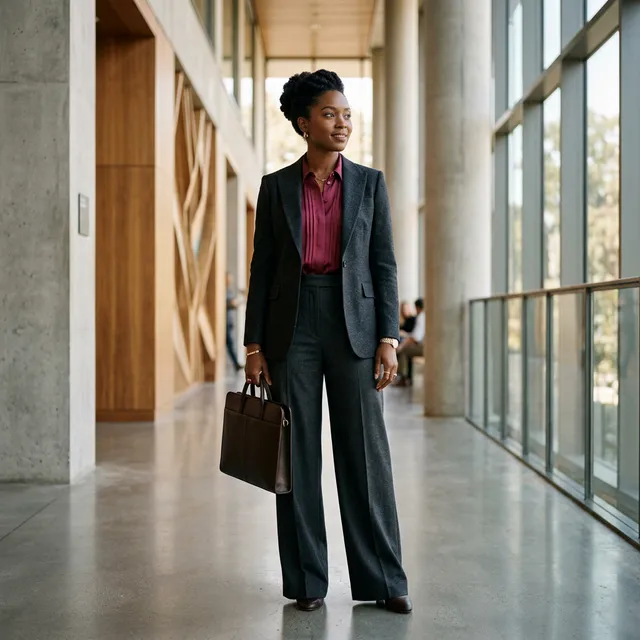
Sarah, a Black woman working in a high-stakes creative agency in Chicago, knows the feeling. She is expected to be "professional," a word that has historically been used to police her very existence. Last Tuesday, she showed up to a client pitch wearing a structured black blazer. But layered underneath it was a sheer, patterned mesh turtleneck—a direct styling cue from an idol group's comeback stage.
"Nobody said a word about it being unprofessional," Sarah noted. "But all day, I could feel the mesh against my skin. It reminded me that I am still me. I didn't leave myself at the door."
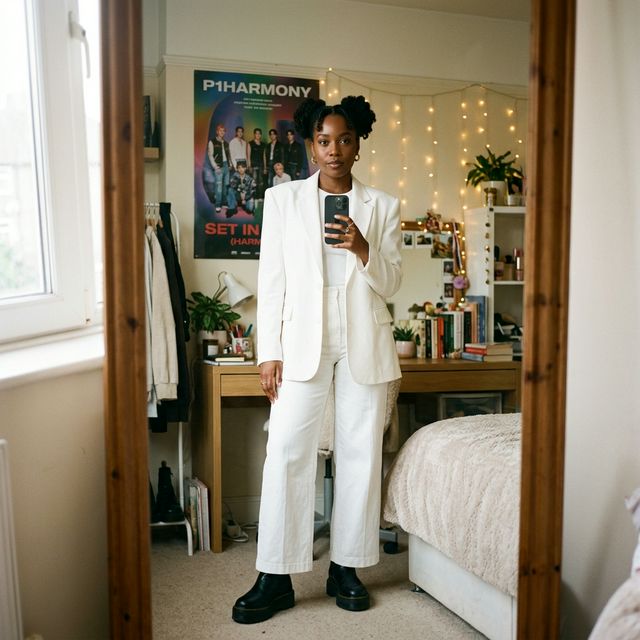
And then there is Nadia, a junior lawyer in London, who insists on wearing chunky, thick-soled loafers and the specific mid-calf ribbed socks she saw on a Music Bank broadcast. When the senior partners look at her feet, they just see practical shoes. When Nadia looks down, she sees the fierce, unapologetic choreography of a girl group that refuses to smile on command.
To dress like an idol in a corporate space is not about copying a trend. It is about borrowing their invincibility for the hours you need it most.
An idol's job is to command the stage, to hold the attention of thousands without breaking a sweat, to look immaculate while performing under impossible pressure. Isn't that exactly what the boardroom demands?
When Mei steps out of the elevator, she doesn't check her reflection in the glass doors. She already knows how she looks. She walks into the conference room, sets her coffee down, and opens her laptop. The tweed jacket sits perfectly on her shoulders.
She smiles at the Vice President. She is ready to perform.
How much of your true self do you have to smuggle into the room just to survive it?
Spin the K-Pop Office Wheel
Mix idol stage energy with professional workplace structures. Spin the boardroom K-pop styling wheel.
Spin the K-Pop Office Wheel