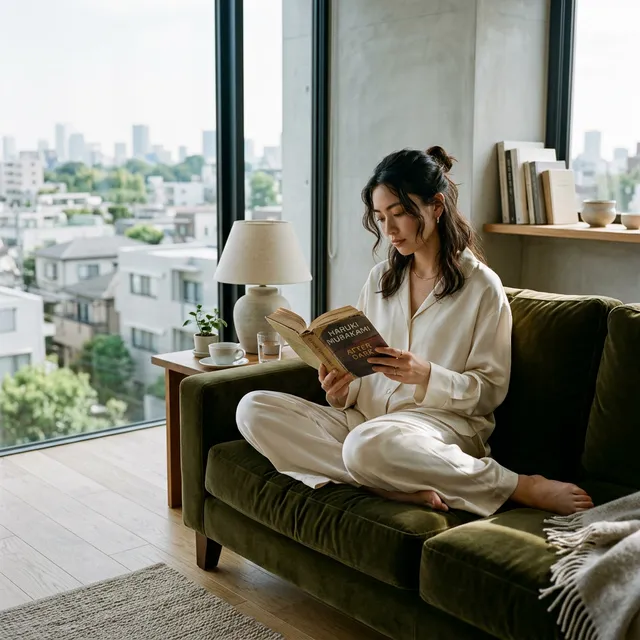
The sunlight in Tokyo has a certain quality of patience. It moves across the minimalist walls of her apartment like a slow-motion clock, illuminating the grain of the wood and the curve of a single ceramic vase. Outside, the city is a frantic miracle of motion, but in here, time has decided to rest.
She is sitting on a velvet sofa, a book open in her lap, but she hasn't turned a page in twenty minutes. She is wearing cream silk lounge pants and a matching top.
It is "lounge wear." It is what you wear when you have nowhere to go and nothing to prove.
For years, she had been a "saver." She saved her best silk for dinners she didn't enjoy. She saved her expensive candles for occasions that never quite arrived. She lived in a constant state of preparation, her wardrobe a waiting room for a life that was always just about to start.
Quiet luxury wasn't about the price of the silk. It was about the audacity to wear it when no one was watching.
The concept of luxury lounge wear was born in the early 20th century as "tea gowns"—garments that allowed women to shed their corsets while still remaining socially "correct" in the privacy of their homes. It was the first instance of fashion prioritizing the sensory experience of the wearer over the visual expectation of the observer. Silk, specifically, has been the fabric of choice for over 5,000 years, not just for its shimmer, but for its protein structure, which mimics the human skin. To wear silk is to wear a second, more perfect version of yourself.
She remembers the closet of her childhood in Kyoto. Her mother’s kimonos were wrapped in acid-free paper, hidden away like sacred relics. They were touched only with white gloves. They were symbols of a status that was preserved rather than lived.
"We protect the best things," her mother would say. "Because once the world touches them, they are gone."
Standing here, with the sun warming her shoulders through the cream silk, she realizes that the only thing she was protecting was her own absence.
The greatest waste of a garment is the day it spends in the dark, waiting for a permission that will never come.
She closes the book. The spine makes a soft, satisfying sound in the quiet room.
She looks at her hands resting on the silk. The fabric is cool, then warm, then invisible.
She reaches for the book on the side table and the silk of her sleeve brushes against the wood with a sound like a held breath, the white walls of the Tokyo apartment catching the slant of the mid-morning sun while she settles deeper into the armchair, and she does not think about the gala next month or the meeting on Monday, she just watches the steam from her tea curl into the air, the fabric of the pants heavy and certain against her skin while the clock on the wall ticks through a minute that belongs to nobody else.
Spin the Everyday Casual Wheel
Bring comfort back to your wardrobe. Spin the everyday casual wheel for sneakers, t-shirts, and relaxed styling.
Spin the Everyday Wheel