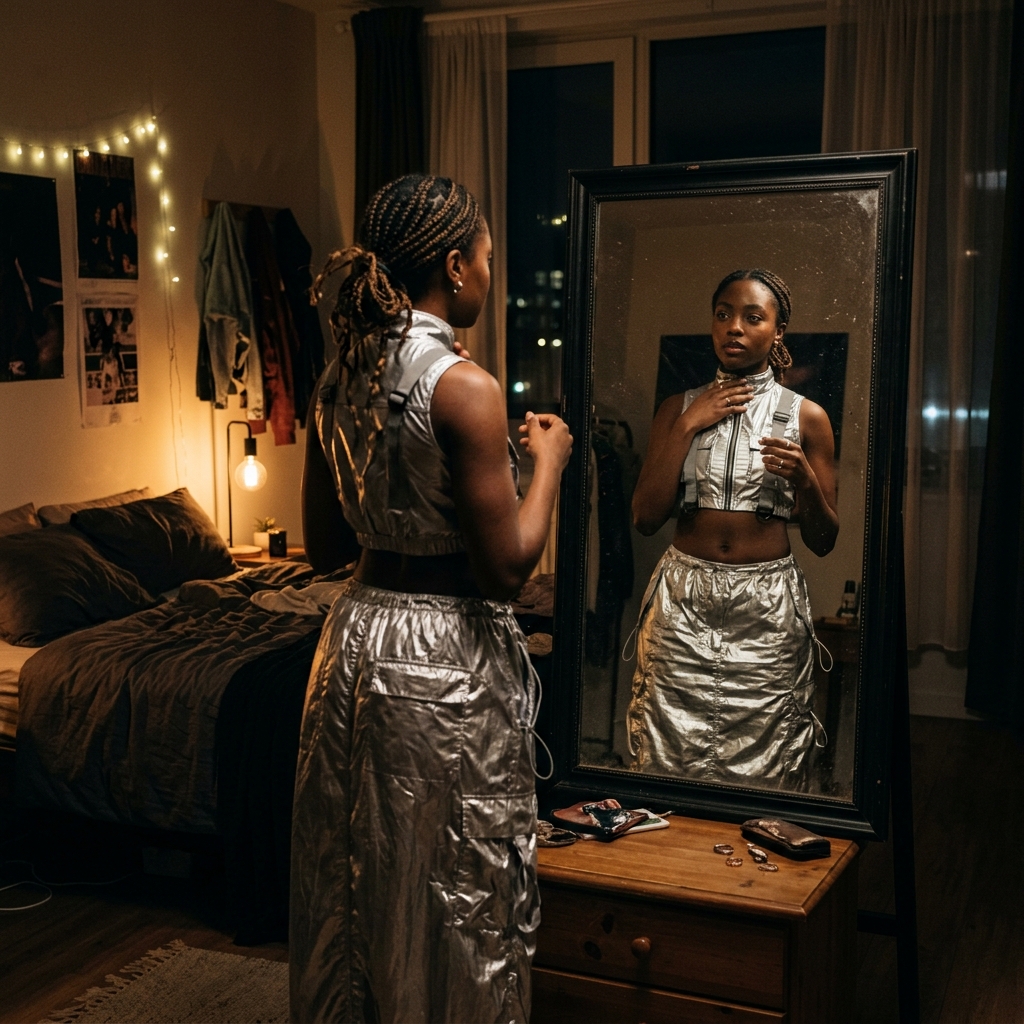
I stared at my phone at 2 AM, completely overwhelmed by the news. I added a metallic Y3K outfit to my cart, thinking a futuristic aesthetic could somehow armor me against an uncertain future. But the ugly truth hanging in our closets is that we are literally running out of raw materials to clothe the planet.
We try to numb the panic with a T-shirt that costs the same as a Big Mac, lying to ourselves that just one more shopping trip will fix the anxiety.
Why does it feel so much easier to buy a disposable future than to simply mend the present?
In a small apartment in London, Sophie sits on the edge of her bed holding a torn silver parachute skirt. It was part of a cheap Y3K outfit she bought three weeks ago to wear to a festival. The fabric is synthetic, thin, and already coming apart at the seams. She considers throwing it away—the landfill is out of sight, out of mind.
But she remembers her grandmother in a 1950s coal-mining town. Her gran didn't wait for tech billionaires to save the planet. She sat with her neighbors, a cigarette in one hand and two knitting needles in the other. When a scratchy acrylic sweater was outgrown, it wasn't discarded. It was unraveled, strand by strand, and knitted into something new.
Thousands of miles away in Nairobi, Amina holds a fast-fashion blazer she bought online. The button popped off during her commute. She sighs, tempted to order another one. It costs almost nothing, after all. But instead, she opens a small metal tin that used to hold cookies. Inside is a tangled mess of thread and a few needles. She threads the needle and begins to stitch.
Both women are searching for the same permission: the permission to stop consuming as a trauma response to the state of the world.
We talk about the "circular economy" like it's a massive, insurmountable technological leap. We look at NASA and marvel at how astronaut space boots eventually became our Nike Air trainers. We assume saving the planet requires interventions we can't possibly control. We think the future looks like a shiny, disposable Y3K outfit.
But the most futuristic, radical act of the 21st century isn't a sustainable plastic polymer. It's a sewing kit. It's the quiet rebellion of keeping the clothes we already have in circulation. It's teaching someone else how to fix a hem so they don't throw a garment away.
If saving our wardrobes is as simple as sewing on one popped button at a time, why are we still so terrified to pick up the needle?
Spin the Futuristic Y3K Wheel
Curious about metallic textures, tech fabrics, and modern fits? Spin our futuristic styling wheel to see the vision.
Spin the Y3K Wheel