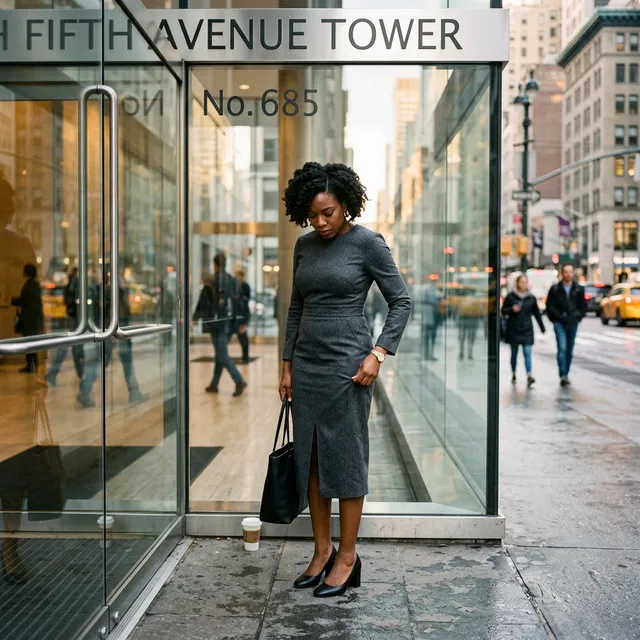
The Shoreditch rooftop is a glass-and-steel island floating above the grime of East London. Below, the Overground hums like a distant hive, but up here, the only sound is the rhythmic clinking of ice in Gin and Tonics and the forced laughter of people who are "collaborating."
The invitation had said Smart Casual.
She stands by the railing, the ivory silk of her top catching the last of the London sunset. It is a beautiful garment, light as a breath, with a neckline that suggests ease. But as she scans the crowd, she realizes that "Smart Casual" is a dialect she hasn't quite mastered.
To her left, a product manager in a vintage tracksuit is holding a craft beer. To her right, a founder in a $500 hoodie is talking about "scaling empathy." They look like they haven't tried at all. They look like they woke up and fell into their success.
She knows better.
The 'Smart Casual' dress code was the tech industry's greatest invention. It allowed the powerful to look like the powerless, and the outsiders to look like they were trying too hard.
The term "Smart Casual" was first used in the early 20th century in American newspapers to describe a "neat but informal" look for men. But it wasn't until the tech boom of the 2010s that it became a weapon of class friction. By removing the suit, the industry didn't remove the hierarchy; it merely hid it behind the cost of a "simple" cotton tee or the rare color of a specific sneaker.
She remembers her father, who grew up in Lagos. He never left the house without a crisp shirt and a watch that told more than just the time. For him, a polished appearance was a defensive posture—a way to claim a dignity that the world wasn't always willing to give. Standing here on this rooftop, in this ivory silk that feels too delicate for the room, she feels that same ancestral itch. The need to be "correct" when everyone around her is pretending that correctness doesn't exist.
She watches a girl in a pair of intentionaly distressed jeans laugh at a joke she probably doesn't find funny. The girl's jeans cost more than the silk top Sarah is wearing. The "smart" part of the casual is the knowledge of what to fake.
When the powerful pretend to be casual, the performance is a luxury. For everyone else, the performance is a requirement.
The sun dips below the horizon and leaves the sky a bruised purple, the lights of the City flickering on like a million tiny fires in the dark, and she takes a sip of the sweet drink while watching the Overground trains move below, their yellow eyes cutting through the London night as she stands there in her ivory silk top, perfectly still while the circle of founders continues to laugh at a joke she can no longer hear.
Spin the Smart Casual Wheel
Don't let networking events stress you out. Spin our curated smart casual styling wheel to dress with confidence.
Spin the Smart Casual Wheel